 4f746842a5
* refactor(components): rename HStack and VStack to RowFlex and ColFlex for clarity rename HStack to RowFlex and VStack to ColFlex across all components to better reflect their purpose as flex containers with row and column directions. This improves code readability and maintainability while keeping the same functionality. All references to these components have been updated accordingly. * refactor(layout): migrate layout components from .ts to .tsx The layout components have been moved from TypeScript (.ts) to TypeScript with JSX (.tsx) to better support JSX syntax and improve type safety. The functionality remains unchanged. * refactor(Layout): convert styled Box component to functional component Improve maintainability by converting styled-component to a functional component with explicit style props. This provides better type safety through CSSProperties interface and makes the component easier to debug. * refactor(Layout): restructure Box component and convert styled components to functional - Replace styled-components with functional components for Stack and Center - Rename style variable to _style in Box component to avoid naming conflict - Add style prop to Box component to allow external style overrides * refactor(components): rename HSpaceBetweenStack to SpaceBetweenRowFlex for clarity * refactor(Layout): pass through props in Stack components Allow additional props to be passed to Stack and its variants for better flexibility. Convert RowFlex from styled component to regular component for consistency. * refactor(Layout): convert SpaceBetweenRowFlex from styled to component Improve maintainability by converting styled component to a regular component that explicitly passes justifyContent prop * refactor(Layout): convert ColFlex to component and type RowFlex props Improve type safety by explicitly omitting flexDirection from StackProps and convert ColFlex from styled component to regular component for consistency * refactor(Layout): convert BaseTypography from styled to component Improve type safety and maintainability by converting styled component to regular React component with TypeScript interface * refactor(Layout): remove unused BaseTypography component * refactor(Layout): remove unused Container component and interface * refactor(layout): rename Stack to Flex and use CSSProperties types The Stack component was renamed to Flex to better reflect its purpose and align with common naming conventions. The interface properties were also updated to use CSSProperties types for better type safety and consistency with CSS standards. * refactor(Layout): move FlexProps interface and comment out unused ButtonProps Clean up component interfaces by moving FlexProps closer to its usage and commenting out unused ButtonProps interface to reduce clutter * refactor(layout): standardize flex props from alignItems/justifyContent to align/justify The changes standardize the flex-related props in the Layout component and across multiple files from using alignItems/justifyContent to the shorter align/justify. This improves consistency and reduces verbosity in the codebase while maintaining the same functionality. All instances of alignItems have been replaced with align and justifyContent with justify in Flex, RowFlex, ColFlex and related components. The changes are purely syntactic and do not affect the actual layout behavior. This refactoring makes the code more maintainable by using a consistent naming convention for flex properties throughout the application. * refactor(Layout): extend BoxProps with React div props * feat(Layout): add flexWrap prop to Flex component interface Add flexWrap property to FlexProps interface to support CSS flex-wrap functionality. Also replace antd Flex with custom Flex component in TagFilterSection. * refactor(components): replace antd Flex with custom Layout components Consolidate Flex component usage across multiple files by replacing antd's Flex with custom Layout components (Flex, ColFlex, RowFlex) for better maintainability and consistency * refactor(components): migrate antd Flex tu custom Flex * refactor(components): update layout component usage for consistency replace RowFlex with ColFlex where appropriate and align prop names * refactor(tests): rename HStack to RowFlex in test components Update test snapshots and mock components to reflect the component name change from HStack to RowFlex Remove unused data-vertical attribute from preview container * refactor(Layout): pass through props and merge styles in Box and Flex components Improve component flexibility by allowing additional props to pass through and properly merging style objects in both Box and Flex components * refactor(Layout): make Flex component props optional with undefined defaults * test: update TagFilterSection snapshot to include wrap style * perf(Layout): optimize Box component style calculation with useMemo * docs: fix typo in Layout component comment * refactor(Layout): update BoxProps to use CSSProperties types Standardize prop types by using CSSProperties for style-related props to improve type safety and consistency with React's style system * feat(Layout): add wrap prop to Flex component * style(TagFilterSection): update snapshot styling to use flex-wrap property * refactor(Layout): simplify layout components by using Tailwind CSS classes Remove custom style calculations and props in favor of Tailwind utility classes * refactor: replace inline styles with Tailwind CSS classes for consistent styling style: update spacing and alignment utilities across components * refactor(tests): update test snapshots to use tailwind classes Replace inline styles with tailwind classes in test snapshots and update test assertions to match. This improves consistency with the codebase's styling approach. * style: adjust spacing and gaps in UI components for consistency * style: replace inline styles with tailwind classes for consistency Refactor various components to use tailwind classes instead of inline styles to maintain consistency and improve readability. Changes include: - Replacing style attributes with tailwind classes for spacing, margins, and padding - Standardizing gap sizes across components - Using tailwind for width, height, and other layout properties - Updating test files to match new class names * style(settings): replace inline styles with tailwind classes for consistency Refactor settings components to use tailwind gap utility instead of inline styles for better maintainability and consistency across the codebase * refactor(styles): replace inline styles with tailwind classes for consistency * feat(eslint): add rule to restrict antd Flex imports Enforce using custom Layout components instead of antd's Flex by adding a restricted import rule * refactor: migrate flex layout from antd props to tailwind classes - Replace antd Flex component props with tailwind classes for consistency - Update gap and alignment values to use tailwind's spacing scale - Remove unused antd Flex imports to clean up dependencies * style(settings): adjust spacing and layout in various settings components - Add gap spacing between elements in multiple settings components - Remove redundant flex class in some components - Standardize gap sizes across related components * refactor(ui): replace inline styles with tailwind classes for consistency Replace various inline style attributes with equivalent tailwind classes across multiple components to maintain consistent styling approach. Changes include margin, padding, width, and flex properties. - Convert style attributes to tailwind classes - Standardize spacing values using tailwind's spacing scale - Improve maintainability by using utility classes * style(ui): adjust spacing in model list group header * style(css): wrap base styles in @layer for better organization * style(css): fix indentation and nesting in global styles * style(settings): adjust spacing in model list and convert subtitle to cn Refactor SettingSubtitle to use cn utility for better className handling Add gap spacing between model list items for improved layout * style(css): move some styles from base layer to outer in index.css * refactor(components): replace HStack with RowFlex for consistency Update layout components to use RowFlex instead of HStack to maintain consistent naming * style: reorder imports in useAppInit and BaseApiClient files * fix(MinAppTabsPool): wrong import path * refactor: update style file extensions from scss to css Update file extensions and comments to reflect the change from SCSS to CSS stylesheets * feat(layout): add Flex component and its variants Introduce new Flex component with Box, RowFlex, SpaceBetweenRowFlex, ColFlex and Center variants to provide reusable layout components * refactor: migrate layout components to @cherrystudio/ui package This commit updates all imports of layout components (Box, Flex, RowFlex, ColFlex, etc.) from '@renderer/components/Layout' to '@cherrystudio/ui' across the codebase. The change also includes updating related test files and eslint configuration to reflect this migration. This refactoring aims to centralize layout components in a shared package for better maintainability and consistency. * docs(eslint): update comment and restricted imports rule Update comment to clarify the purpose of the rule and add a TODO note for future migration * docs(ui): update migration status for layout components Mark Layout/* components as migrated and refactored in both Chinese and English documentation * docs: update migration status for Layout components |
||
|---|---|---|
| .github | ||
| .husky | ||
| .vscode | ||
| .yarn | ||
| build | ||
| docs | ||
| migrations | ||
| packages | ||
| resources | ||
| scripts | ||
| src | ||
| tests | ||
| .editorconfig | ||
| .env.example | ||
| .git-blame-ignore-revs | ||
| .gitattributes | ||
| .gitignore | ||
| .npmrc | ||
| .oxlintrc.json | ||
| .yarnrc.yml | ||
| biome.jsonc | ||
| CLAUDE.md | ||
| CODE_OF_CONDUCT.md | ||
| components.json | ||
| CONTRIBUTING.md | ||
| dev-app-update.yml | ||
| electron-builder.yml | ||
| electron.vite.config.ts | ||
| eslint.config.mjs | ||
| LICENSE | ||
| package.json | ||
| playwright.config.ts | ||
| README.md | ||
| SECURITY.md | ||
| tsconfig.json | ||
| tsconfig.node.json | ||
| tsconfig.web.json | ||
| vitest.config.ts | ||
| yarn.lock | ||

English | 中文 | Official Site | Documents | Development | Feedback












🍒 Cherry Studio
Cherry Studio is a desktop client that supports multiple LLM providers, available on Windows, Mac and Linux.
👏 Join Telegram Group|Discord | QQ Group(575014769)
❤️ Like Cherry Studio? Give it a star 🌟 or Sponsor to support the development!
🌠 Screenshot
🌟 Key Features
- Diverse LLM Provider Support:
- ☁️ Major LLM Cloud Services: OpenAI, Gemini, Anthropic, and more
- 🔗 AI Web Service Integration: Claude, Perplexity, Poe, and others
- 💻 Local Model Support with Ollama, LM Studio
- AI Assistants & Conversations:
- 📚 300+ Pre-configured AI Assistants
- 🤖 Custom Assistant Creation
- 💬 Multi-model Simultaneous Conversations
- Document & Data Processing:
- 📄 Supports Text, Images, Office, PDF, and more
- ☁️ WebDAV File Management and Backup
- 📊 Mermaid Chart Visualization
- 💻 Code Syntax Highlighting
- Practical Tools Integration:
- 🔍 Global Search Functionality
- 📝 Topic Management System
- 🔤 AI-powered Translation
- 🎯 Drag-and-drop Sorting
- 🔌 Mini Program Support
- ⚙️ MCP(Model Context Protocol) Server
- Enhanced User Experience:
- 🖥️ Cross-platform Support for Windows, Mac, and Linux
- 📦 Ready to Use - No Environment Setup Required
- 🎨 Light/Dark Themes and Transparent Window
- 📝 Complete Markdown Rendering
- 🤲 Easy Content Sharing
📝 Roadmap
We're actively working on the following features and improvements:
- 🎯 Core Features
- Selection Assistant with smart content selection enhancement
- Deep Research with advanced research capabilities
- Memory System with global context awareness
- Document Preprocessing with improved document handling
- MCP Marketplace for Model Context Protocol ecosystem
- 🗂 Knowledge Management
- Notes and Collections
- Dynamic Canvas visualization
- OCR capabilities
- TTS (Text-to-Speech) support
- 📱 Platform Support
- HarmonyOS Edition (PC)
- Android App (Phase 1)
- iOS App (Phase 1)
- Multi-Window support
- Window Pinning functionality
- 🔌 Advanced Features
- Plugin System
- ASR (Automatic Speech Recognition)
- Assistant and Topic Interaction Refactoring
Track our progress and contribute on our project board.
Want to influence our roadmap? Join our GitHub Discussions to share your ideas and feedback!
🌈 Theme
- Theme Gallery: https://cherrycss.com
- Aero Theme: https://github.com/hakadao/CherryStudio-Aero
- PaperMaterial Theme: https://github.com/rainoffallingstar/CherryStudio-PaperMaterial
- Claude dynamic-style: https://github.com/bjl101501/CherryStudio-Claudestyle-dynamic
- Maple Neon Theme: https://github.com/BoningtonChen/CherryStudio_themes
Welcome PR for more themes
🤝 Contributing
We welcome contributions to Cherry Studio! Here are some ways you can contribute:
- Contribute Code: Develop new features or optimize existing code.
- Fix Bugs: Submit fixes for any bugs you find.
- Maintain Issues: Help manage GitHub issues.
- Product Design: Participate in design discussions.
- Write Documentation: Improve user manuals and guides.
- Community Engagement: Join discussions and help users.
- Promote Usage: Spread the word about Cherry Studio.
Refer to the Branching Strategy for contribution guidelines
Getting Started
- Fork the Repository: Fork and clone it to your local machine.
- Create a Branch: For your changes.
- Submit Changes: Commit and push your changes.
- Open a Pull Request: Describe your changes and reasons.
For more detailed guidelines, please refer to our Contributing Guide.
Thank you for your support and contributions!
🔧 Developer Co-creation Program
We are launching the Cherry Studio Developer Co-creation Program to foster a healthy and positive-feedback loop within the open-source ecosystem. We believe that great software is built collaboratively, and every merged pull request breathes new life into the project.
We sincerely invite you to join our ranks of contributors and shape the future of Cherry Studio with us.
Contributor Rewards Program
To give back to our core contributors and create a virtuous cycle, we have established the following long-term incentive plan.
The inaugural tracking period for this program will be Q3 2025 (July, August, September). Rewards for this cycle will be distributed on October 1st.
Within any tracking period (e.g., July 1st to September 30th for the first cycle), any developer who contributes more than 30 meaningful commits to any of Cherry Studio's open-source projects on GitHub will be eligible for the following benefits:
- Cursor Subscription Sponsorship: Receive a $70 USD credit or reimbursement for your Cursor subscription, making AI your most efficient coding partner.
- Unlimited Model Access: Get unlimited API calls for the DeepSeek and Qwen models.
- Cutting-Edge Tech Access: Enjoy occasional perks, including API access to models like Claude, Gemini, and OpenAI, keeping you at the forefront of technology.
Growing Together & Future Plans
A vibrant community is the driving force behind any sustainable open-source project. As Cherry Studio grows, so will our rewards program. We are committed to continuously aligning our benefits with the best-in-class tools and resources in the industry. This ensures our core contributors receive meaningful support, creating a positive cycle where developers, the community, and the project grow together.
Moving forward, the project will also embrace an increasingly open stance to give back to the entire open-source community.
How to Get Started?
We look forward to your first Pull Request!
You can start by exploring our repositories, picking up a good first issue, or proposing your own enhancements. Every commit is a testament to the spirit of open source.
Thank you for your interest and contributions.
Let's build together.
🏢 Enterprise Edition
Building on the Community Edition, we are proud to introduce Cherry Studio Enterprise Edition—a privately-deployable AI productivity and management platform designed for modern teams and enterprises.
The Enterprise Edition addresses core challenges in team collaboration by centralizing the management of AI resources, knowledge, and data. It empowers organizations to enhance efficiency, foster innovation, and ensure compliance, all while maintaining 100% control over their data in a secure environment.
Core Advantages
- Unified Model Management: Centrally integrate and manage various cloud-based LLMs (e.g., OpenAI, Anthropic, Google Gemini) and locally deployed private models. Employees can use them out-of-the-box without individual configuration.
- Enterprise-Grade Knowledge Base: Build, manage, and share team-wide knowledge bases. Ensures knowledge retention and consistency, enabling team members to interact with AI based on unified and accurate information.
- Fine-Grained Access Control: Easily manage employee accounts and assign role-based permissions for different models, knowledge bases, and features through a unified admin backend.
- Fully Private Deployment: Deploy the entire backend service on your on-premises servers or private cloud, ensuring your data remains 100% private and under your control to meet the strictest security and compliance standards.
- Reliable Backend Services: Provides stable API services and enterprise-grade data backup and recovery mechanisms to ensure business continuity.
✨ Online Demo
🚧 Public Beta Notice
The Enterprise Edition is currently in its early public beta stage, and we are actively iterating and optimizing its features. We are aware that it may not be perfectly stable yet. If you encounter any issues or have valuable suggestions during your trial, we would be very grateful if you could contact us via email to provide feedback.
Version Comparison
| Feature | Community Edition | Enterprise Edition |
|---|---|---|
| Open Source | ✅ Yes | ⭕️ Partially released to customers |
| Cost | Free for Personal Use / Commercial License | Buyout / Subscription Fee |
| Admin Backend | — | ● Centralized Model Access ● Employee Management ● Shared Knowledge Base ● Access Control ● Data Backup |
| Server | — | ✅ Dedicated Private Deployment |
Get the Enterprise Edition
We believe the Enterprise Edition will become your team's AI productivity engine. If you are interested in Cherry Studio Enterprise Edition and would like to learn more, request a quote, or schedule a demo, please feel free to contact us.
- For Business Inquiries & Purchasing: 📧 bd@cherry-ai.com
🔗 Related Projects
-
one-api: LLM API management and distribution system supporting mainstream models like OpenAI, Azure, and Anthropic. Features a unified API interface, suitable for key management and secondary distribution.
-
ublacklist: Blocks specific sites from appearing in Google search results
🚀 Contributors
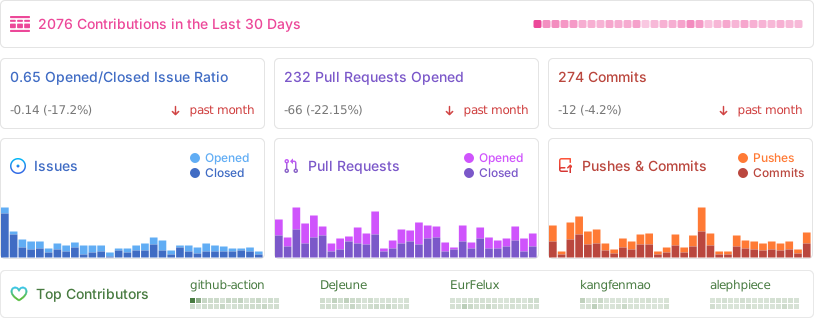
📊 GitHub Stats